
 Seth Hansen

How PowerFilm Helped GEM Build a Better Solar Solution for Their Low-Speed Electric Vehicles
 Seth Hansen : October 1, 2025

This blog post was co-created with AI.
When fleets evaluate solar for commercial trucking, understanding how it is used across fleets helps put performance claims into context. Lab ratings and nameplate wattage provide limited insight into how a system will perform under varying weather conditions or how solar improves efficiency in real-world trucking conditions across different routes, vibration, and non-optimal sun angles. To understand how solar panels actually perform in daily fleet operations, performance must be measured where it matters most: on the road.
To understand how solar panels actually perform in daily fleet operations, Nussbaum, a nationally recognized carrier, conducted a side-by-side, over-the-road evaluation of two commercial truck solar solutions. The goal was straightforward: determine which system consistently delivers more usable energy to the truck’s battery system under real operating conditions.
The results were clear. In real-world fleet operation, PowerFilm’s 440W solar system delivered an average of 74% more usable energy to truck battery systems than a competing 500W solution. Despite a lower-rated wattage, the PowerFilm system consistently supplied more energy where it matters most: to the batteries.
This evaluation shows why fleets that rely solely on rated wattage risk underestimating real-world solar performance and operational impact.
Take this blog post with you!
Commercial trucking presents a demanding environment for solar systems. Trucks experience changing orientations, intermittent shading, vibration, weather variability, and inconsistent parking angles. Under these conditions, the key question is not how much power a panel is rated for, but how much energy actually reaches the battery system over time.
Because of these realities, the fleet focused this evaluation on measured energy delivery rather than theoretical output. The objective was to determine which solar solution offered the best combination of real-world power delivery, battery-charging effectiveness, and operational value for long-haul trucking applications.
Four Freightliner Cascadia tractors were equipped with electric auxiliary power units that featured identical monitoring hardware to enable a direct, side-by-side comparison. Two trucks were outfitted with a PowerFilm 440W flexible solar system, while two received a competing 500W system.
Each vehicle was equipped with a 300-amp Victron current shunt installed between the solar charge controller and the EPU battery pack. This configuration allowed precise measurement of the current delivered by the solar panels while continuously monitoring the battery voltage during normal operation.
System performance data was recorded using a Victron Cerbo GX data logger, capturing measurements at 15-minute intervals throughout the test period. Over the course of the evaluation, each truck generated more than 43,000 data points, providing a detailed view of solar energy delivery during real-world driving and parking cycles.
To ensure reliable data collection, each system included cellular connectivity for real-time uploads and onboard SD card backup storage. Integrated GPS antennas tracked vehicle locations, enabling performance data to be correlated with routes, regions, and environmental conditions. This confirmed that all vehicles operated across comparable geographies and duty cycles.
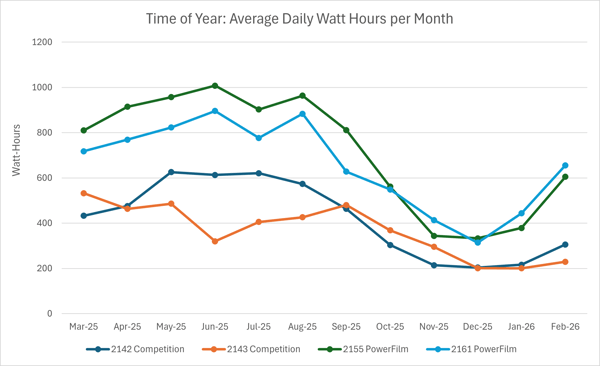
The monthly trend data shows that the performance gap remained consistent across seasons, reinforcing that the difference was driven by system efficiency rather than temporary conditions.
Throughout the evaluation, performance data was integrated over time to calculate the total watt-hours of solar energy delivered to each truck’s battery system during real-world operation.
When all four trucks were actively collecting data, the results showed a consistent and meaningful performance gap. The PowerFilm 440W solar system delivered, on average, more than 1.74 times the total energy to the battery pack compared to the competing 500W system. Importantly, this comparison reflects actual measured energy delivered to the batteries and is not adjusted for rated panel wattage or modeled output.
On average, the difference was equally significant. The 440W system averaged 686 watt-hours per day, while the competing system averaged 395 watt-hours per day. These figures represent actual energy supplied during normal fleet operations, not under laboratory conditions or idealized assumptions.
Energy delivery was calculated by integrating measured power over time, providing an accurate picture of how much solar energy actually reached the battery systems across months of operation.
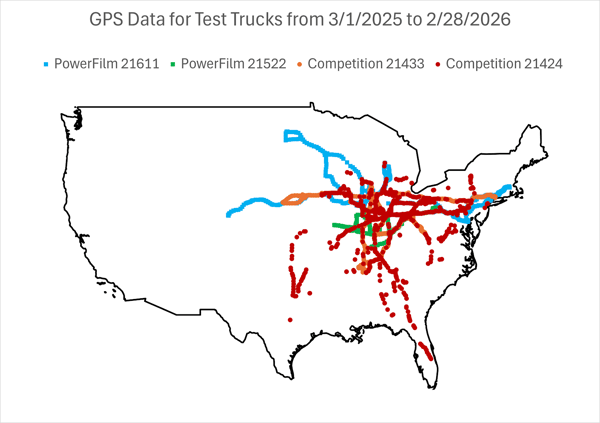
The overlapping route density visible in the GPS data confirms that both solar systems operated across similar duty cycles, routes, and sunlight exposure. This validation ensures that observed performance differences were driven by solar system efficiency and electrical design rather than variations in geography, operating patterns, or environmental conditions. Keep in mind that the hours of available sun are greater in the south than in the north, giving the competitor’s 500W solution a slight advantage.
Despite its lower rated wattage, the 440W system consistently supplied more usable power where it mattered most: at the batteries.
For fleet managers, higher real-world energy delivery translates directly into operational reliability and cost control. When more solar energy reaches the battery system each day, auxiliary systems remain online longer, batteries maintain healthier states, helping prevent battery failure in real-world trucking conditions, and trucks rely less on engine idling for power.
For example, higher daily solar energy delivery helps maintain battery charge during multi-day layovers or extended idle-restricted stops, reducing the likelihood of low-voltage events when drivers return to service.
In practical terms, this can mean fewer jump-start events, reduced strain on EPUs, and fewer unplanned downtime incidents related to low battery conditions. Over time, these improvements lead to lower battery-related maintenance costs, higher uptime, and reduced fuel consumption from idling or engine-based charging, all of which contribute to the ROI of solar for commercial trucking fleets.
Rather than relying solely on higher wattage ratings, fleets benefit most from solar systems that consistently deliver usable energy across real routes, weather, and operating schedules.
This evaluation reinforces a critical lesson for commercial trucking applications: rated panel wattage does not equal delivered energy.
Factors such as electrical configuration, resistance losses, panel durability, temperature coefficient, and performance in non-ideal orientations all influence how effectively solar energy is converted into usable battery power over time, especially under the toughest road conditions. In real-world fleet operation, these factors often outweigh laboratory ratings.
In this case, a lower-rated solar system consistently delivered significantly more energy to the battery system than a higher-rated alternative. The results highlight the importance of evaluating solar solutions based on measured performance in real operating conditions rather than solely on nameplate specifications.
For fleets considering solar integration, this side-by-side, real-world evaluation demonstrates the value of focusing on delivered energy rather than rated wattage. Across comparable routes, seasons, and operating conditions, the tested solar system consistently delivered more usable power to the truck’s battery.
By delivering higher real-world energy output where it matters most, fleet-optimized solar technology can help reduce idling, improve battery reliability, and lower total operating costs without adding complexity or weight. For fleet managers, real-world data like this provides a clearer path to informed, confident solar decisions.
Real-world testing shows how much energy a solar system actually delivers to a truck’s battery under normal operating conditions.
Fleet solar systems designed for real operating conditions can help support:
The right solar solution should be based on real-world results, not just rated wattage.
Contact us to explore whether fleet solar makes sense for your fleet.
How did PowerFilm outperform the competitor in fleet solar testing?
In side-by-side, over-the-road fleet testing, PowerFilm’s 440W solar system consistently delivered more usable energy to the truck’s battery system than a competing 500W solution. Performance was measured as watt-hours delivered to the batteries during normal operation, rather than estimated output or nameplate ratings.
What made the difference in real-world performance?
Fleet data showed that PowerFilm’s solar panels converted available sunlight into usable battery power more effectively across real routes, weather conditions, and operating schedules. The performance advantage was attributed to panel durability and electrical design optimized for real-world trucking environments rather than idealized test conditions.
How much additional power did PowerFilm deliver during the test?
During the evaluation period, the PowerFilm system delivered, on average, 291 Wh more energy per day to the battery system than the competing solution. This difference was based on measured energy delivered during normal fleet operation and reflects sustained real-world performance rather than controlled or theoretical output.
Were the test routes and operating conditions comparable?
Yes. GPS tracking confirmed that all test vehicles operated along similar routes and in comparable geographic regions, experiencing comparable weather patterns and daylight exposure. This ensured that performance differences were driven by solar system efficiency and design rather than operating conditions. Keep in mind that the number of hours of solar irradiation is higher in the south and slowly decreases as you go north.
Can PowerFilm solar panels be integrated into existing fleet equipment?
Yes. PowerFilm’s solar solutions are designed to integrate with standard truck electrical systems and electric auxiliary power units, making them suitable for both fleet retrofits and OEM installations without adding unnecessary complexity.
Take this blog post with you!