 Seth Hansen

What's The Return on Investment for a Commercial Trucking Solar Solution?
 Seth Hansen : August 6, 2025
This blog post was co-created with AI.
Commercial trucks rely on batteries for much more than starting the engine. Electric APUs, liftgates, refrigeration units, telematics, lights, and other electronics all add to the electrical load.
Those loads do not always stop when the engine shuts off.
For fleet managers, the result can be dead batteries, jump-starts, unnecessary idling, shorter battery life, and lost vehicle uptime. Commercial truck solar panels can help by providing supplemental charging throughout the day.
Solar will not replace an alternator, electric APU, or truck engine. Instead, it helps maintain battery charge and offset electrical loads when the truck is parked, driving, or sitting between routes.
The key is matching the solar system to the problem you need to solve.
Take this blog post with you!
Modern trucks and trailers use more electrical equipment than ever. Some loads run continuously. Others draw large amounts of power for short periods.
A truck's alternator can recharge its batteries while the engine runs, but that approach has limits. Short routes, long stops, overnight parking, hotel loads, and repeated equipment use can consume more energy than the vehicle replaces.
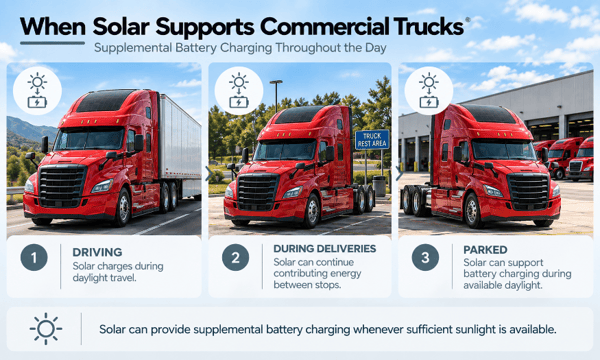
During daylight hours, commercial truck solar panels can supply energy to the battery system whether the vehicle is moving or parked. This can help maintain a higher state of charge and reduce how often the engine needs to run just to recharge the batteries.
The benefits depend on the application, duty cycle, battery bank, available solar area, and electrical load.
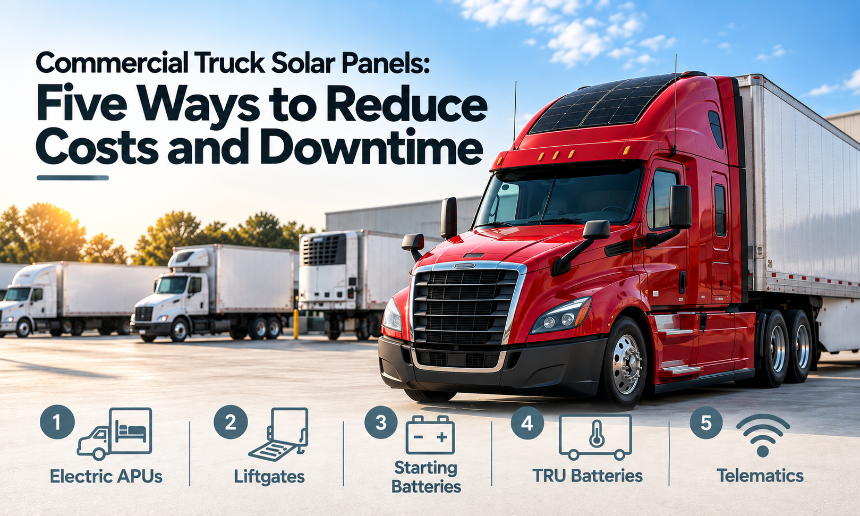
Here are five applications where solar can make a meaningful difference.
Sleeper trucks need power when drivers stop for breaks or overnight rest. HVAC systems, refrigerators, lights, televisions, fans, and personal electronics all add to the load.
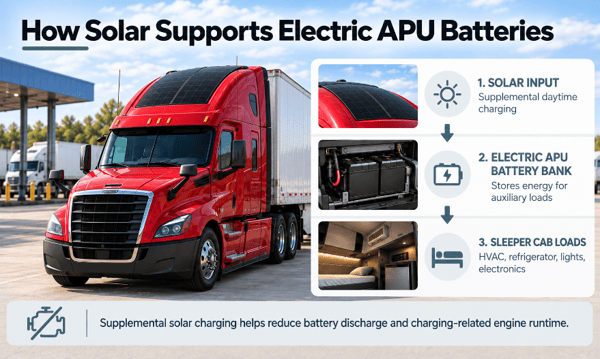
Diesel APUs can provide that power without running the truck's main engine. Electric APUs rely on batteries instead.
When an electric system drains its batteries, the truck may need an engine auto-start event or another charging source to restore them. Those starts consume fuel and add engine hours.
Solar provides another energy source during daylight hours. Instead of waiting for the alternator or shore power to replenish the batteries, the solar system can keep charging whenever there's enough sunlight.
That doesn't mean solar alone can run an air conditioner through every overnight stop. HVAC systems can require far more power than the solar array produces at any given moment.
The value comes from reducing the net energy pulled from the batteries. The less deeply batteries discharge, the less energy the truck must replace later.
C.R. England tested a PowerFilm 440W solar system on a Freightliner Cascadia with demanding hotel loads.
The test included a refrigerator, cabin lights, radio, television, gaming system, bunk fan, and intermittent use of the microwave and heater.
During the month-long evaluation, the PowerFilm-equipped truck did not require a battery-driven engine auto-start charging event. The batteries remained charged enough to support the electrical loads throughout the test.
Results will vary with weather, HVAC use, battery capacity, driver behavior, and duty cycle. However, the test shows how properly sized solar can reduce engine runtime for charging in the right application.
Read more about the C.R. England solar field evaluation.
Liftgates create a very different electrical challenge.
A liftgate may only operate for a few minutes at each stop, but moving a heavy load requires significant power. On a busy delivery route, those cycles repeat throughout the day.
Short drive times between stops may not give the truck's charging system enough time to replace the energy the liftgate uses.
Eventually, drivers may encounter slower liftgate operation, low battery voltage, or a liftgate that cannot complete its job.
Solar can produce energy throughout daylight hours, even when the truck isn't moving.
The panels can charge while the truck is driving, making a delivery, unloading cargo, or parked between routes. That extra charging time matters on high-cycle routes.
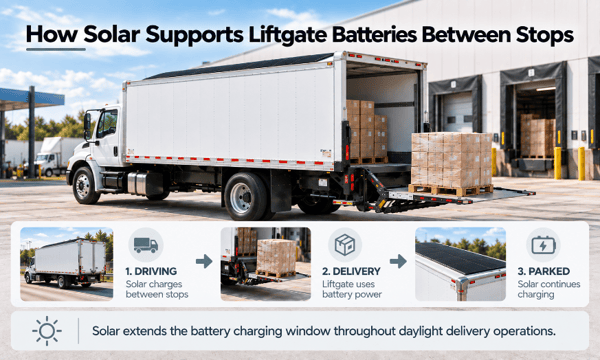
A PowerFilm customer tested a 440W liftgate solar system using four 110W panels. The test simulated a demanding delivery route with 29 complete lift cycles and 2,000-pound pallet loads.
After all 29 cycles, battery voltage under load dropped from about 12.24V to 12.15V, a roughly 0.09V decrease. Part of the test also occurred under partly cloudy and shaded conditions.
Keeping voltage higher can help reduce electrical stress. When voltage drops, a motor may draw more current to deliver the same mechanical output, increasing heat and wear.
For fleets that use liftgates frequently, the goal isn't simply adding solar. It is sizing the system around the actual route and liftgate duty cycle.
Learn more about how solar power improves liftgate reliability in commercial trucking.
A parked truck isn't necessarily electrically inactive.
Telematics systems, engine control modules, alarms, tracking equipment, clocks, sensors, and other electronics can continue drawing small amounts of current after shutdown.
Each load may seem minor. Over several days or weeks, however, the total drain can leave a starting battery below the charge level needed to crank the engine.
Extreme temperatures can worsen the problem, especially for vehicles that sit unused for extended periods.
A small solar charging system can offset some or all of these parasitic loads during daylight hours. The goal is straightforward: replace energy as the truck consumes it.
For some maintenance applications, the required solar system may be relatively small. More complex vehicles with higher continuous loads need more capacity.
Solar does not prevent every battery failure. Old batteries, damaged wiring, failed components, extreme loads, and other problems can still cause a truck to go down.
But maintaining a healthier state of charge can address one common cause of dead starting batteries.
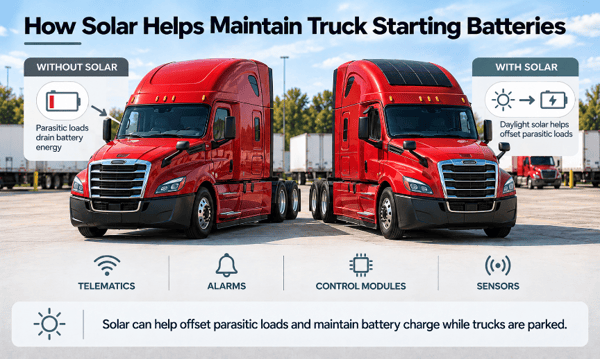
One jump-start may not seem like a major expense, but when repeated across dozens or hundreds of vehicles, the cost adds up quickly.
Fleet managers should consider more than the roadside service price. A dead battery can also mean driver delays, technician time, missed schedules, towing costs, and a vehicle that cannot perform revenue-producing work.
Preventing even a portion of those events can change a solar charging system's economics.
For more detail, read “How to Mitigate Your Truck Batteries' Parasitic Draw with Solar Panels”.
Solar for transportation refrigeration units (TRUs) is often misunderstood.
A small panel mounted near a TRU generally doesn't run the refrigeration compressor directly. Instead, it supports the electrical system and maintains the TRU battery.
TRUs depend on batteries for controls, starting, telematics, and other electrical functions. Those batteries can lose charge while trailers sit at docks, yards, distribution centers, or other locations.
Solar provides a charging source during those periods.
Maintaining the TRU battery can reduce the need to use other equipment solely to restore its charge.
Solar can also support trailer telematics and monitoring systems that must remain online when a trailer is disconnected from a tractor.
For refrigerated fleets, reliability matters even more. Temperature-sensitive products depend on the refrigeration system operating when needed, and a healthy battery supports that reliability.
The right solar solution depends on the TRU model, battery, electrical loads, mounting area, and operating conditions. A low-wattage maintenance panel may suffice for some applications, while others need more charging capacity.
Explore solar solutions for transportation refrigeration units to learn more.
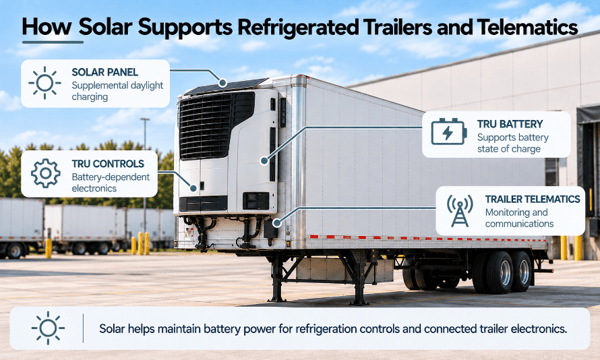
Telematics have become a core part of fleet operations.
GPS tracking, cargo monitoring, diagnostic systems, electronic logging, sensors, cameras, and communications equipment all depend on electrical power.
A tractor may have a large starting battery bank and charge frequently via the alternator. A disconnected trailer may have a much smaller battery with no regular charging source.
Yet fleet managers may still expect that trailer to report its location and status.
Solar can help maintain the battery that supports those electronics.
That is especially useful for trailers and other assets that spend long periods disconnected from a tractor. The solar panel can continue producing power without requiring an engine, shore-power connection, or manual charging routine.
The concept also extends beyond basic GPS tracking. Cargo sensors, door sensors, tire monitoring, security equipment, cameras, and other connected devices continue to expand commercial fleets' electrical requirements.
As fleets add more electronics, maintaining reliable battery power becomes increasingly important.
Read more about reliable solar-powered telematics in commercial trucks.
No single solar panel wattage works for every commercial truck.
A system designed to offset a small parasitic load has a very different job from one supporting an electric APU or high-cycle liftgate.
Start with the electrical load. Determine how much energy the equipment consumes and how many hours per day it operates.
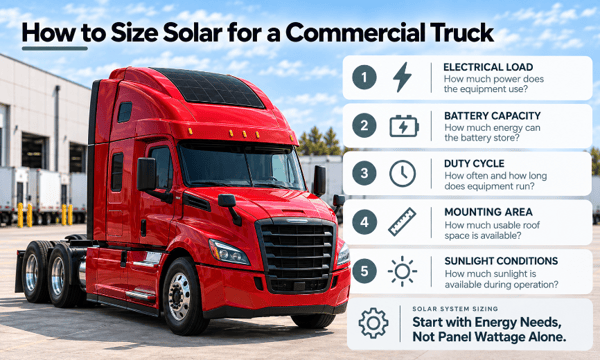
For example, a device drawing 20 watts for 10 hours consumes 200 watt-hours (Wh) of energy. This distinction matters because watts describe power, while watt-hours measure energy used or produced over time.
Next, consider battery voltage and capacity, how deeply the batteries discharge, and how much charging they receive from the alternator or another source.
Vehicle duty cycle also matters. Does the truck run for ten hours every day? Does it make dozens of short stops? Does it sit for a week between uses? Is the trailer often disconnected from the tractor?
Available mounting area and sunlight matter just as much. Trucks and trailers have limited usable surfaces, and solar panels don't operate at their rated output every hour.
Clouds, shade, panel orientation, season, latitude, dirt, and other conditions all affect energy production.
That's why sizing a commercial truck solar system should start with daily energy requirements rather than how many watts fit on the roof.
When comparing commercial truck solar panels, rated wattage is only part of the equation. Two systems with similar power ratings can deliver very different amounts of energy during normal fleet operations.
Nussbaum conducted a real-world evaluation comparing PowerFilm's 440W solar system with a competing 500W solution. Four Freightliner Cascadia tractors participated in the evaluation, and the equipment measured how much solar energy reached their electric APU batteries.
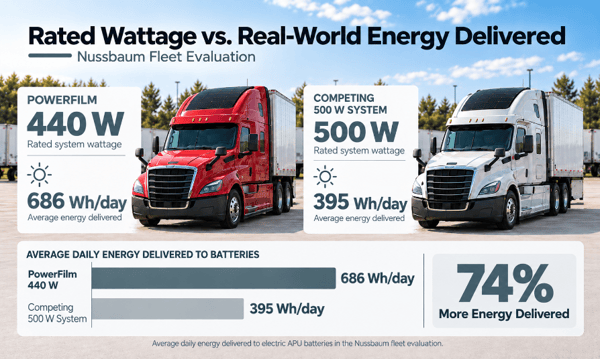
Despite its lower rated wattage, the PowerFilm system delivered an average of 686 watt-hours per day, compared to 395 watt-hours from the competing system. That's about 74% more usable energy delivered to the batteries in this evaluation.
For fleet managers, this highlights an important distinction: a system's energy output over time matters more than its advertised wattage alone.
Panel performance under changing sunlight, temperature, shading, and mounting conditions can influence how effectively solar supports the truck's electrical loads.
When evaluating commercial truck solar solutions, compare measured daily energy delivery, not just nameplate ratings. This gives a clearer picture of how well a system can maintain battery charge, support auxiliary equipment, and reduce engine runtime for charging.
For a closer look at the testing methods, equipment, and results, read PowerFilm's real-world solar performance comparison for trucking fleets.
Not every vehicle needs solar.
The best candidates usually have a clear electrical or operational problem that supplemental charging can address.
Look for vehicles with recurring dead batteries, frequent jump-starts, long parked periods, high parasitic loads, electric APUs, repeated liftgate use, charging-related idling, or electronics that need to remain online while the engine is off.
Fleet maintenance records can help identify these vehicles. If one model, route, or duty cycle generates a disproportionate number of battery service events, it may be a good place to test solar.
A controlled pilot can provide better information than making assumptions across an entire fleet.
Solar ROI should connect directly to the problem the system solves.
For an electric APU application, reduced charging-related idling may create much of the value. For a liftgate, avoiding service events and protecting batteries may matter more. For telematics, the value may come from maintaining asset visibility and avoiding manual battery charging.
Fleet managers can evaluate costs such as:
Don't assume every truck will have the same payback period. Duty cycle, fuel price, solar exposure, battery type, system size, electrical loads, and installation costs all affect the result.
Before installing solar, track battery-related service calls, charging-related engine starts, and vehicle downtime for a representative group of trucks.
After installation, compare those results over a similar operating period. This helps determine whether the system delivers measurable savings under actual fleet conditions.
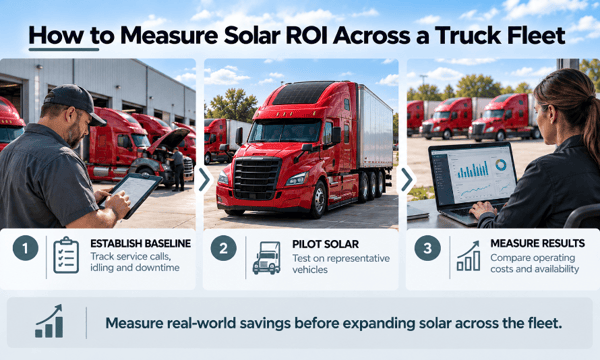
A better approach is to identify a recurring fleet cost, set a baseline, install a properly sized solar system, and measure the change.
For additional guidance, explore the return on investment for a commercial trucking solar solution.
Commercial truck solar panels work best when they solve a defined problem.
That might mean keeping an electric APU battery charged longer, maintaining a liftgate battery through a demanding delivery route, reducing dead starting batteries, supporting a TRU, or keeping trailer telematics online.
The starting question should not be, "How much solar can we put on this truck?"
Ask instead, "What electrical problem are we trying to solve?"
From there, look at the electrical load, battery system, duty cycle, operating environment, available mounting area, and current charging sources.
That information lets you design a solar solution around the vehicle rather than forcing the vehicle to fit a standard solar kit.
If battery failures, charging-related idling, or auxiliary electrical loads are increasing fleet costs, PowerFilm can help. Explore our commercial trucking solar solutions and request a quote to find the right fit for your fleet.
Solar panels typically do not provide enough energy to propel a commercial truck. Instead, commercial truck solar panels provide supplemental electricity to charge batteries and power auxiliary systems. They can support starting batteries, electric APUs, liftgates, TRU batteries, telematics, and other electrical equipment.
There is no standard wattage for every truck. The right system depends on the electrical load, battery capacity, vehicle duty cycle, available mounting area, operating environment, and existing charging sources. A battery-maintenance application may need far less solar capacity than an electric APU or high-cycle liftgate application.
Solar can reduce some charging-related engine runtime by supplying energy to batteries during daylight hours. The amount of idling that can be reduced depends on the electrical load, solar system size, battery capacity, sunlight, and vehicle duty cycle. Solar does not eliminate every reason a truck may need to idle.
Solar panels can help maintain battery state of charge by replacing energy lost to parasitic loads and other electrical equipment. This can reduce battery problems caused by insufficient charging, especially when vehicles sit for extended periods. Solar cannot prevent failures caused by damaged batteries, wiring problems, failed components, or other electrical issues.
Yes. One advantage of solar is that it can continue charging batteries during daylight hours when the engine is off. That makes solar useful for parked tractors, disconnected trailers, liftgate batteries, telematics systems, and other equipment that may otherwise have no active charging source.
They can be when they solve a recurring and measurable fleet problem. Fleet managers should compare system costs against expenses such as charging-related fuel use, jump-starts, roadside service, battery replacement, technician labor, driver downtime, and lost vehicle availability. A pilot installation can help determine the potential return before expanding solar across a fleet.
Not necessarily. A solar panel's rated wattage reflects its output under standard test conditions. Actual energy production depends on sunlight, temperature, shading, installation, and system design. In a Nussbaum fleet evaluation, PowerFilm's 440W system delivered approximately 74% more daily energy to the batteries than a competing 500W system. Fleet managers should compare measured energy delivery rather than relying on rated wattage alone.
Take this blog post with you!