
 Seth Hansen

How Solar Power Enhances Liftgate Reliability in Commercial Trucking
 Seth Hansen : December 1, 2025

This blog post was co-created with AI.
Extreme weather is a leading cause of truck battery failure in commercial fleets, directly affecting uptime, delivery schedules, and operating costs.
Cold reduces battery capacity, heat accelerates degradation, and parasitic electrical loads drain batteries during idle periods, turning minor issues into costly downtime.
This post explains how temperature impacts truck batteries, compares common battery types, and shows how solar charging helps prevent weather-related failures.
Truck batteries rely on chemical reactions to produce power. Temperature controls how efficiently those reactions occur. Cold slows them down. Heat accelerates degradation.
Solar systems are also affected by temperature, which is why panel selection and design matter. This is covered in more detail in a previous blog post on how temperature affects solar panel design and performance, and why certain technologies perform better in extreme environments.
Take this blog post with you!

Lead-acid batteries remain the most common option in commercial trucking. They are proven and affordable, but they are highly sensitive to temperature and state of charge.
Cold-weather truck battery failure typically follows a predictable sequence:
State of charge is the key variable.
Lead-acid batteries freeze at different temperatures depending on their state of charge.
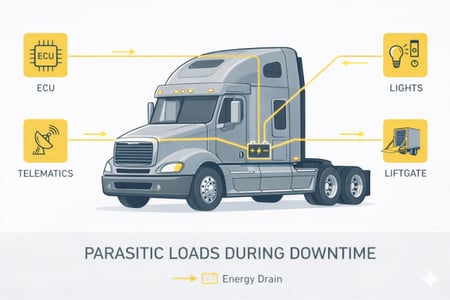
Many trucks remain partially charged because the systems continue to draw power even when the engine is off.
Common sources of battery drain include:
Liftgates are a frequent cause of parked battery drain, especially on delivery vehicles that cycle them throughout the day. Repeated use slowly depletes the battery while the truck is parked, especially when shut off and not allowed to idle. This is why fleets benefit from using solar to improve liftgate reliability, as demonstrated in real-world liftgate applications.
These conditions drive many winter battery failures.
.jpg?width=450&height=300&name=Solar-panel-battery-power-system-diagram%20(Web).jpg)
Solar charging for trucks helps prevent battery failure in extreme weather by maintaining a higher state of charge during idle and parked periods. Truck-mounted solar charging works by supplying a small, steady current whenever light is available.
Solar does not eliminate the need for healthy batteries or proper electrical system maintenance, but it significantly reduces the conditions that cause batteries to fail.
A common question is whether solar still helps when the engine is running. In practice, solar continues to generate power in multiple operating states, including while the truck is in motion, as explained in a previous blog post on how solar works when the truck’s engine is running.
As a result of solar charging:
In cold-climate delivery fleets, maintaining battery charge during multi-day parking periods can prevent Monday-morning no-start events, a common trigger for emergency service calls and delayed routes.
Even a small 24-50W truck-mounted solar panel can help maintain battery charge during idle periods, reducing jump-starts and extending battery life.
Fleet managers report fewer service calls, improved cold-start performance, and higher uptime with minimal maintenance. Solar also works well alongside other systems. Solar panels paired with APUs and EPUs reduce idling, fuel costs, and engine wear.
Solar does not replace batteries; it works alongside them as part of a broader electrical system.
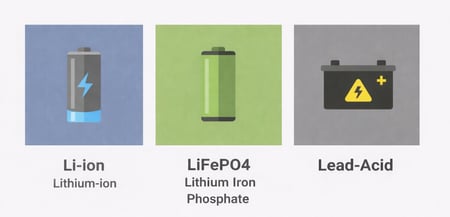
While lead-acid batteries remain the most common option in commercial trucking, some fleets are evaluating lithium-based alternatives to improve efficiency and reduce maintenance costs.
Once temperature and state of charge are understood, the next question for many fleets is whether changing battery chemistry alone can solve cold- and hot-weather reliability issues.
Lithium-based systems are the most common alternative to lead-acid, but they introduce new temperature-related considerations.
Lithium batteries offer higher energy density and longer cycle life than lead-acid batteries. However, temperature affects lithium systems differently.
Most lithium batteries share several limitations:
A truck parked in freezing temperatures may not recharge its lithium battery without an integrated heating system, even if power is available. Solar can still help by reducing overall load and stabilizing voltage during system operation. Solar can also offset some of the energy usage on the system with heated batteries
Standard lithium options include:
Cold-weather battery issues are rarely sudden. They develop over time.
A truck parks for the weekend. Parasitic systems continue drawing power. Overnight temperatures drop. On Monday morning, the truck will not start.
The result is familiar to fleet managers:
These failures follow a clear and repeatable pattern.

Truck-mounted solar panels interrupt the parked-drain cycle that leads to battery failure.
Solar charging for trucks provides:
Fleet managers also see measurable cost benefits. Reduced service calls, fewer jump-starts, and longer battery life contribute to strong returns, as outlined in the ROI of truck solar solutions.
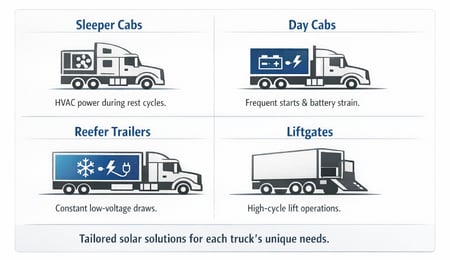
Not all trucks operate the same way. Effective solar systems match real-world usage.
This is why fleets benefit from solar solutions engineered for a range of truck applications, from sleepers and day cabs to liftgates and refrigerated trailers.
Charge-maintenance issues, not battery defects, are the most common cause of truck battery failures in extreme weather.
If your fleet regularly experiences:
These are signs of chronic state-of-charge loss.
Solar addresses the problem at its source by maintaining battery state of charge, protecting lead-acid batteries in freezing conditions and reducing unnecessary drain on lithium systems. The result is fewer failures, less downtime, and more reliable fleet operations in extreme weather.
Explore solar charging solutions for commercial trucking that reduce jump-starts, cold starts, and battery-related downtime.
Have questions about fit, sizing, or applications? Contact our team to discuss your fleet’s needs.
Why do truck batteries fail in cold weather?
Truck batteries fail in cold weather because low temperatures reduce available capacity and cranking power, especially when batteries are not fully charged. As a battery’s state of charge drops, the electrolyte inside it freezes at much higher temperatures. A fully discharged lead-acid battery can freeze around 32°F, while a fully charged battery will not freeze until extreme subzero conditions. Parasitic electrical loads often leave batteries partially discharged, which makes cold-weather failure far more likely.
Does solar charging work in winter?
Yes. Truck-mounted solar panels continue to generate power in winter whenever light is available, helping maintain battery state of charge and reducing freeze-related failures.
Can solar prevent parasitic battery drain?
Solar does not eliminate electrical loads, but it offsets parasitic battery drain by supplying continuous trickle charging while trucks are parked or idle.
How does solar help prevent truck battery failures?
Solar helps prevent truck battery failures by maintaining battery state of charge during parked and idle periods. Truck-mounted solar panels provide a steady trickle charge whenever light is available, which offsets parasitic electrical loads. By keeping batteries closer to full charge, solar reduces the risk of freezing in cold weather and limits deep discharge in hot conditions. This prevents slow charge loss, which leads to no-start events, jump-starts, and emergency service calls. Solar does not replace batteries, but it protects them by addressing the root cause of many weather-related failures.
Take this blog post with you!
.jpg)