
 Seth Hansen
How Solar Supports Persistent Autonomy in Uncrewed Maritime Systems
 Seth Hansen : August 11, 2026
This blog post was co-created with AI.
High-altitude aircraft can stay above weather, cover large areas, and support missions that once required satellites or conventional aircraft. But persistent flight creates a difficult engineering problem: the aircraft needs energy to keep operating, while every added gram affects the platform.
For high-altitude pseudo-satellites (HAPS), stratospheric airships, communications platforms, and other long-endurance aircraft, simply adding more batteries has limits. More stored energy means more mass. More mass can affect propulsion requirements, payload capacity, and overall aircraft design.
Solar changes that equation by allowing the aircraft to generate energy during flight. But successful solar integration requires more than adding photovoltaic modules to an available surface.
Engineers must consider power-to-weight ratio, solar collection area, energy storage, aerodynamics, mission loads, and the complete power architecture as one system.
Take this blog post with you!
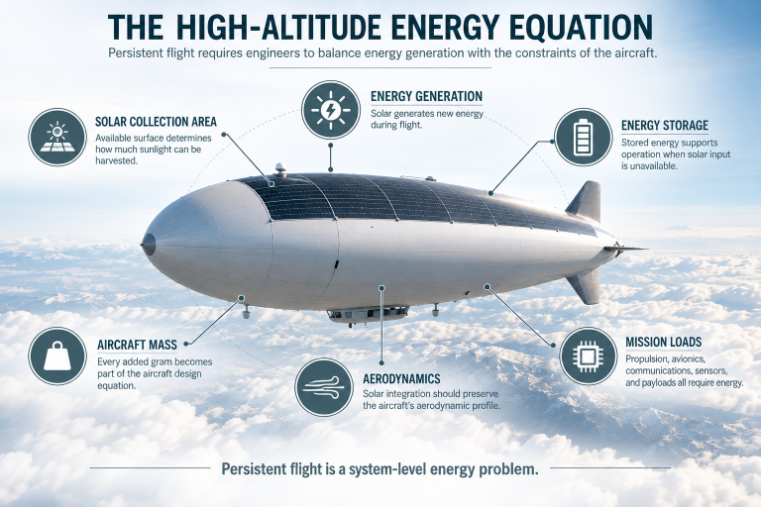
Long-endurance aircraft must do more than stay airborne.
The aircraft may need to power propulsion, flight controls, communications, sensors, computing hardware, and other mission equipment for hours, days, or longer. High-altitude communications and ISR platforms may also need continuous power for payloads that directly support the mission.
PowerFilm's high-altitude solar systems are designed around these requirements, with ultralight construction, conformal integration, low-profile lamination, custom electrical architecture, and durability for high-altitude conditions.
All of those factors matter because energy generation cannot come at the expense of the aircraft's primary mission.
That creates an important question for system designers:
How can the aircraft increase available energy without adding more mass than the platform can support?
Batteries are essential for many long-endurance aircraft, especially when missions extend beyond daylight hours. But increasing battery capacity comes with a clear tradeoff.
More battery capacity provides more stored energy. It also adds mass.
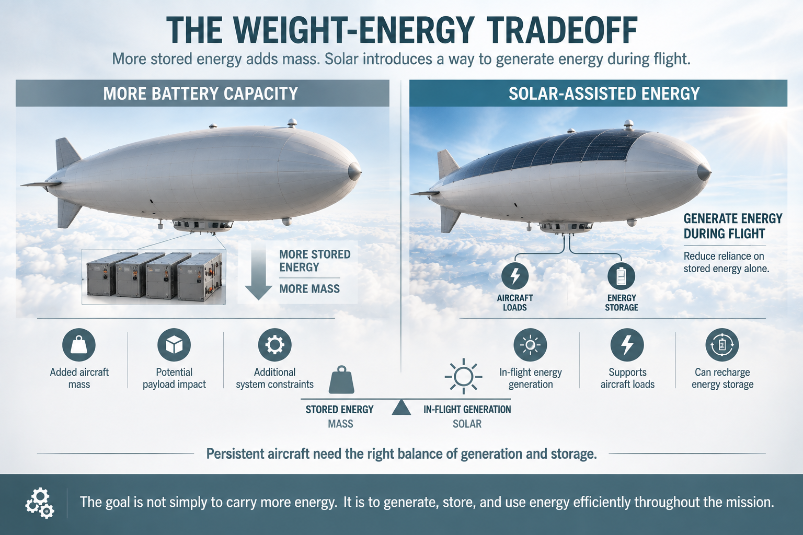
That added mass can influence the rest of the aircraft. Depending on the platform, engineers may need to account for changes in propulsion requirements, structural design, payload capacity, or other system constraints.
This is where onboard solar generation becomes valuable.
Instead of carrying all required mission energy from launch, a solar-equipped aircraft can collect new energy throughout the day. That energy can support immediate aircraft loads while also charging batteries for periods when solar energy is unavailable.
Solar does not eliminate the need for energy storage. It changes how engineers can approach the relationship between generation and storage.
Our article, "Solar Panels vs. Batteries vs. Power Supplies: What You Need to Know," explains the different roles generation, storage, and power electronics play within a complete energy system.
For persistent aircraft, the goal is not simply to carry more energy. It is to create a system that can generate, store, and use energy efficiently throughout the mission.
Solar module efficiency often receives significant attention when engineers compare photovoltaic technologies. For weight-sensitive aircraft, efficiency alone does not tell the whole story.
The aircraft must also carry the solar system.
For a closer look at what solar efficiency measures and why the highest efficiency does not always mean the best real-world performance, read our article, “Solar Cell Efficiency Explained: How It's Measured and Why It Matters.”
Two solar technologies may produce similar amounts of power from the same area while adding very different amounts of mass.
For a ground installation, that weight difference may have little effect on system performance. For an aircraft, every additional gram becomes part of the engineering equation.
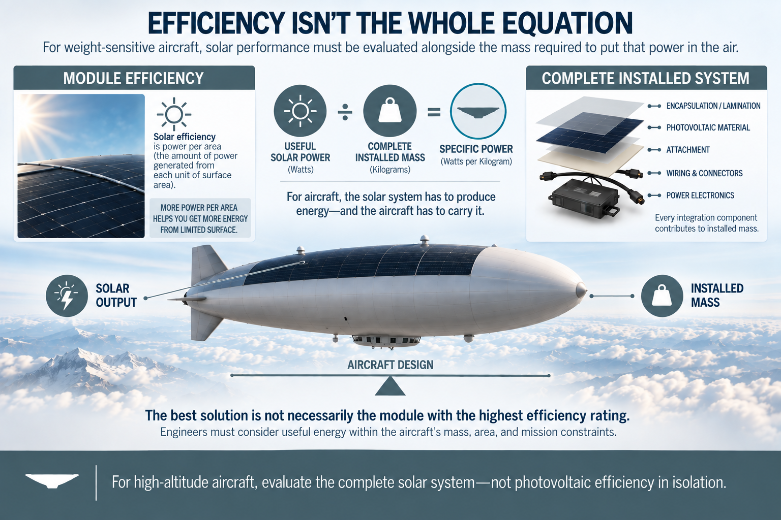
Power-to-weight ratio therefore becomes an important measure when evaluating solar for high-altitude applications.
PowerFilm's approach for these platforms focuses on ultralight thin-film or crystalline silicon construction and a high power-to-weight ratio to minimize the mass impact of onboard solar generation.
The best solution is not necessarily the module with the highest efficiency rating. Engineers need to evaluate how much useful energy the solar system can provide within the aircraft's mass, area, and mission constraints.
Module weight is only part of the calculation.
A complete solar installation may include encapsulation, adhesives, wiring, connectors, power electronics, and other integration materials. Mounting methods can also add mass or create structural requirements elsewhere in the aircraft.
That means engineers should consider the installed solar system rather than evaluating the photovoltaic material in isolation.
Reducing weight at the module level helps, but designing the complete integration around the aircraft can deliver additional gains.
High-altitude aircraft do not always provide large, flat surfaces designed for conventional solar panels.
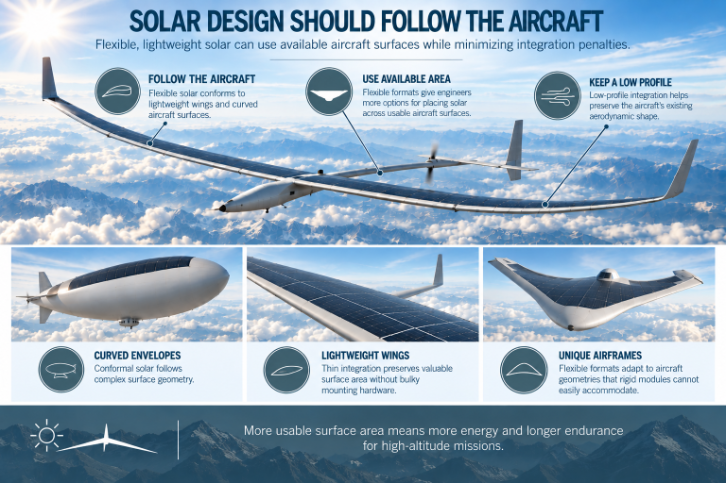
Airships have curved envelopes. Fixed-wing HAPS platforms may have long, lightweight wings. Other aircraft may provide limited usable surface area around control surfaces, payloads, antennas, or structural features.
The solar system needs to work with those surfaces, not fight them.
PowerFilm's high-altitude systems use flexible formats designed to conform to curved envelopes and wing surfaces. Low-profile lamination also helps maintain aerodynamic performance.
A solar installation that changes airflow or requires substantial mounting hardware can create new design challenges.
Thin, conformal solar allows engineers to integrate energy generation closer to the existing surface profile.
On a weight-sensitive aircraft, usable surface area is valuable.
Flexible solar gives designers more options for placing photovoltaic material across surfaces that may not work with rigid modules.
The result is more than a packaging benefit. It lets solar collection area become part of the aircraft design earlier.
For a solar aircraft pursuing persistent operation, the goal is not to generate enough power at noon.
The aircraft must manage energy across an entire operating cycle.
During daylight hours, the solar array may need to support aircraft loads while also producing enough additional energy to recharge onboard storage. As solar input falls later in the day, the aircraft increasingly depends on stored energy. Overnight, batteries may need to support the aircraft until solar generation resumes after sunrise.
The cycle looks roughly like this:
Solar generation → daytime aircraft loads → battery charging → nighttime stored energy → sunrise → solar generation
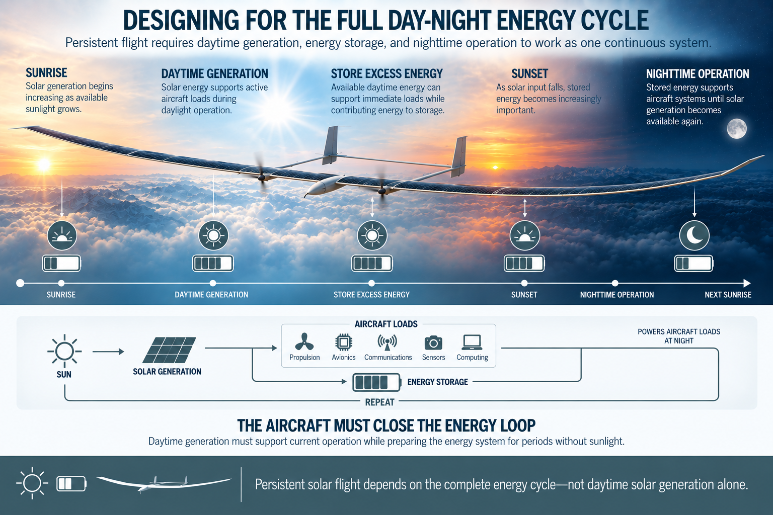
That cycle repeats during persistent operations.
This is why solar array sizing and battery sizing cannot happen independently. Increasing solar generation may provide more charging energy during the day. Increasing battery capacity may provide more nighttime energy, but it also adds mass.
Engineers must find a balance that works across the entire mission profile.
Energy generation is only one side of the equation. Engineers also need to understand where that energy goes.
A high-altitude platform may divide available power among:
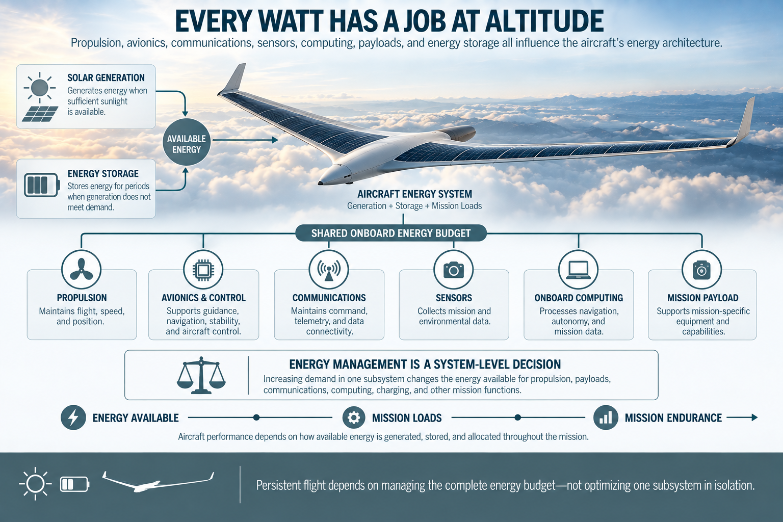
Those loads may also change throughout the mission.
A communications platform, for example, may need continuous power for its communications payload. An ISR aircraft may have changing sensor and data-processing requirements. A hybrid aircraft may use solar to supplement onboard energy systems rather than provide all operating power.
A well-designed power architecture must account for propulsion, avionics, payloads, energy storage, and other onboard systems.
That system-level approach matters because adding solar capacity alone does not guarantee longer endurance. The aircraft has to collect, manage, store, and distribute that energy effectively.
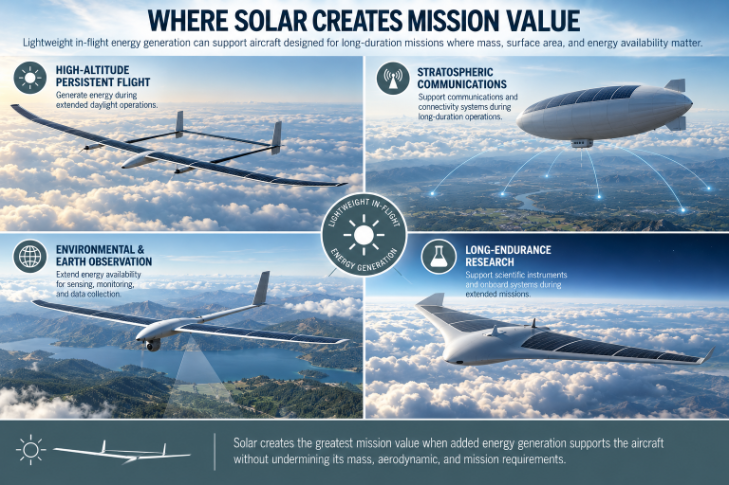
Different high-altitude platforms can use solar in different ways.
High-altitude airships can use solar to support propulsion, avionics, and communications payloads. The goal is persistent energy generation that supports multi-day or multi-month deployments while reducing reliance on battery mass.
HAPS platforms operate with tight mass and energy budgets. Ultralight solar can help provide persistent stratospheric power without requiring the aircraft to carry all mission energy at launch.
Communications platforms may need continuous power for communications payloads and remote operations. Onboard solar generation can reduce dependence on stored energy and support longer missions.
ISR and environmental monitoring aircraft can use extended endurance to keep sensors operating over an area for longer periods. Solar becomes part of the energy architecture supporting the aircraft and its mission payload.
PowerFilm identifies each of these areas, along with defense and research programs, as potential applications for custom high-altitude solar architectures.
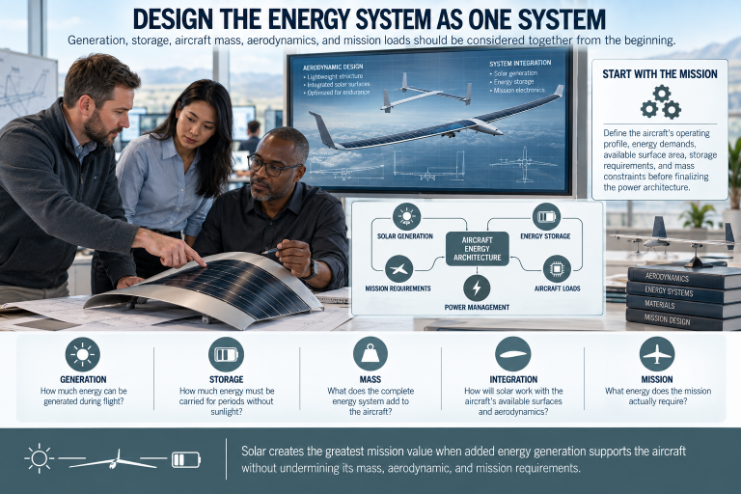
Solar integration works best when engineers treat it as part of the aircraft's energy system, not a component added late in development.
That approach also aligns with PowerFilm's "Custom Solar Design Process," which moves projects from concept development and design review through prototyping, field testing, and production.
Identify propulsion, avionics, communications, payload, and other loads. Then consider how those loads change throughout the operating cycle.
For a deeper look at this process, our "Comprehensive Guide: Solar Power Budgeting and System Design" walks through power consumption, energy storage, available illumination, system losses, and solar panel sizing.
This creates a clearer picture of how much energy the aircraft needs to generate and store.
Available solar energy changes with time, aircraft orientation, operating conditions, and other mission variables. As we explain in "Solar Intensity Explained: Why Solar Panel Performance Depends on More Than Sunshine," available solar energy, not simply how bright or sunny conditions appear, determines how much power a solar system can produce.
Rated module output alone cannot answer whether the aircraft has enough energy to complete its mission.
Compare solar technologies based on the complete integration, not only photovoltaic efficiency.
Modules, wiring, lamination, power electronics, attachment methods, and other components all contribute to system mass.
Solar and batteries solve different parts of the endurance problem.
Solar creates energy when conditions allow. Batteries store energy for later use. The right balance depends on the aircraft, its loads, and its mission profile.
A single solar specification does not determine high-altitude endurance.
It comes from balancing power generation, energy storage, aircraft mass, available surface area, aerodynamics, propulsion, avionics, and mission payloads.
For engineers developing HAPS, high-altitude airships, communications platforms, and other persistent aircraft, the most useful question may not be, "How efficient is the solar panel?"
A better question is, "How much mission energy can the complete solar system provide for the mass we add to the aircraft?"
PowerFilm develops ultralight, conformal solar solutions and custom power architectures for weight-sensitive high-altitude platforms. Explore our solar solutions for high-altitude and airship platforms to learn more, or submit your project requirements to start the engineering discussion.
Solar allows an aircraft to generate energy during flight instead of relying entirely on energy stored before launch. Depending on the platform, that energy can support aircraft loads and recharge batteries for later use.
HAPS platforms operate under strict mass constraints. Added solar-system mass can affect payload capacity and other aircraft design requirements, so engineers need to consider power output relative to installed weight.
Solar does not generate energy at night. Persistent solar aircraft therefore need an energy strategy that accounts for nighttime operation, which may include battery storage and careful management of aircraft loads.
Power-to-weight ratio compares the electrical power a solar system can produce with the mass it adds to the aircraft. It can provide a more useful comparison for weight-sensitive platforms than efficiency alone.
Flexible solar can conform to curved envelopes and other surfaces that rigid modules can't accommodate. A conformal, low-profile design can also help minimize integration and aerodynamic penalties.
Engineers can evaluate solar most effectively by considering it early alongside the aircraft's energy budget, storage system, available surface area, mass constraints, avionics, propulsion, and mission requirements.
Take this blog post with you!

.jpg)
