
 Seth Hansen
The Weight-Energy Tradeoff: Designing Solar Power for High-Altitude Aircraft
 Seth Hansen : September 15, 2026
This blog post was co-created with AI.
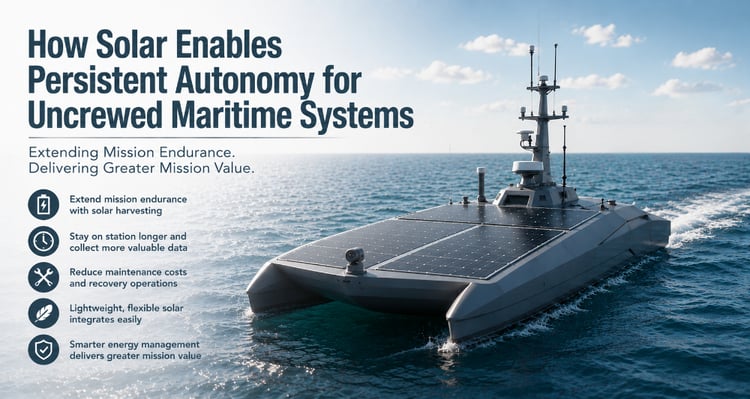
Every autonomous maritime mission eventually reaches one of two outcomes: the mission is complete, or the platform runs out of energy.
For engineers developing today's uncrewed maritime systems, extending that mission has become one of the industry's biggest design challenges. Whether a platform is inspecting offshore wind farms, monitoring ocean conditions, collecting hydrographic data, supporting maritime security, or gathering scientific observations, every onboard subsystem competes for a limited supply of energy.
This challenge isn't unique to maritime applications. As we explored in our article, How Solar Extends Runtime for Autonomous Agricultural Robots, autonomous platforms across industries face many of the same engineering constraints. Whether operating in a crop field or hundreds of miles offshore, designers must balance energy consumption, payload capacity, weight, and mission endurance.
As autonomous missions become longer and more sophisticated, simply adding larger batteries is no longer enough. Engineers are rethinking how energy is generated, stored, and managed throughout a mission. Solar is becoming an increasingly important part of that conversation, not because it replaces batteries, but because it helps autonomous platforms make better use of the energy they already carry.
Take this blog post with you!
Autonomous maritime systems are taking on missions that would have been difficult, expensive, or impractical just a few years ago.
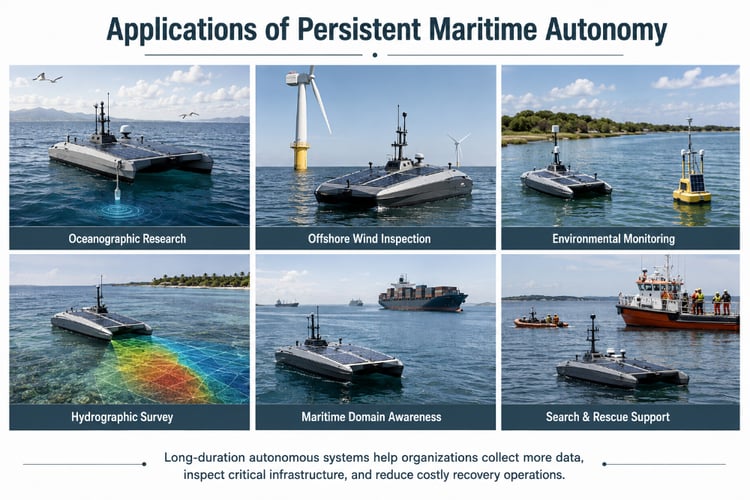
Offshore wind farms continue expanding farther from shore, increasing inspection distances and reducing opportunities for routine servicing. Ocean researchers are deploying autonomous platforms for longer environmental monitoring campaigns. Governments are investing in maritime domain awareness to strengthen coastal security. At the same time, advances in artificial intelligence allow autonomous vessels to process more information and make more decisions without direct operator involvement.
These advances all have one thing in common: they require more energy.
A platform that remains operational for an additional day can inspect more infrastructure, collect more scientific observations, or provide longer surveillance coverage without deploying another vessel or crew. In many applications, extending mission endurance directly improves operational efficiency while reducing lifecycle costs.
Persistent autonomy has become an engineering objective rather than simply an operational goal.
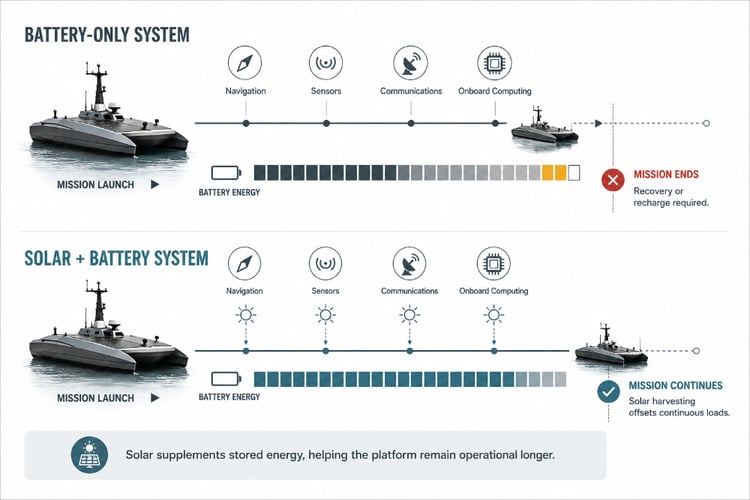
Every autonomous maritime mission starts with a finite amount of available energy.
From launch until recovery, that energy must support propulsion, navigation, communications, onboard computing, environmental sensors, and mission-specific payloads. Every subsystem draws from the same shared energy budget, making efficient power management just as important as battery capacity.
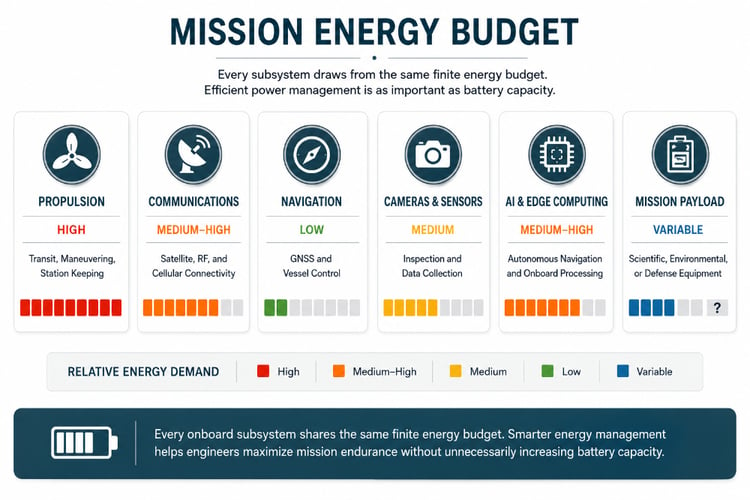
The challenge is not simply carrying more energy. It is deciding how to use every watt-hour as effectively as possible.
Consider an autonomous vessel inspecting offshore wind infrastructure. Increasing the frequency of satellite communications provides operators with more real-time information, but it also consumes additional power. Adding new imaging sensors improves inspection quality while reducing available battery capacity for propulsion. Engineers continuously balance these tradeoffs to maximize mission value.
This systems-level approach is becoming a defining characteristic of successful autonomous platform design.
If you'd like to explore this process in more detail, our Comprehensive Guide: Solar Power Budgeting and System Design + Step-by-Step Example walks through how engineers estimate energy consumption, size batteries, evaluate available sunlight, and design reliable solar-assisted power systems. The methodology applies equally well to autonomous maritime platforms.
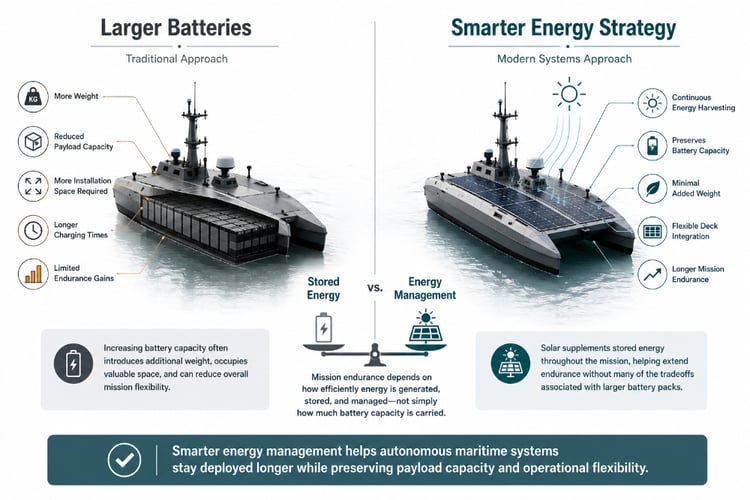
When mission endurance becomes a priority, increasing battery capacity often appears to be the simplest solution.
In practice, larger batteries introduce new engineering compromises.
Additional batteries increase system weight, consume valuable installation space, extend charging times, and may reduce payload capacity. On compact uncrewed surface vehicles (USVs), these tradeoffs can affect vessel performance, stability, and mission flexibility.
Instead of relying exclusively on stored energy, many engineers are changing the question they ask.
Rather than asking, "How much energy can we carry?"
They ask, "How can we generate, preserve, and use energy more efficiently throughout the mission?"
That shift in thinking has made energy harvesting an increasingly important part of autonomous maritime system design.
Solar works best as a complementary energy source rather than a replacement for batteries.
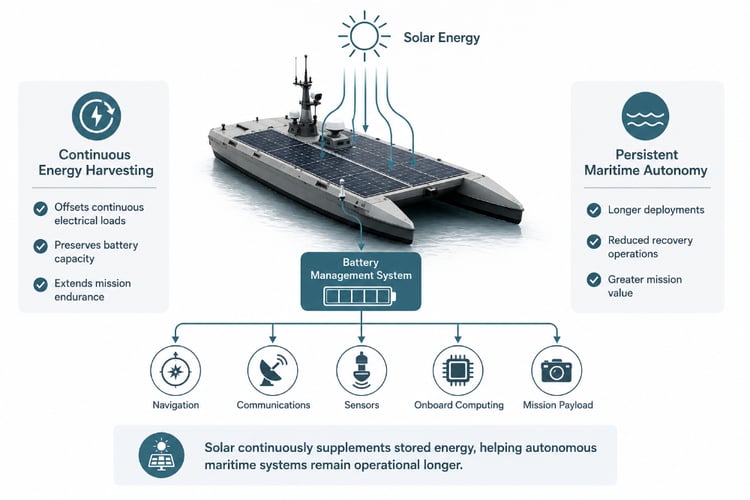
Flexible solar modules generate electricity whenever sunlight is available, helping power onboard electronics while reducing continuous battery discharge. Over multi-day or multi-week deployments, even modest amounts of supplemental power can meaningfully improve operational endurance.
Depending on the mission profile, solar can help:
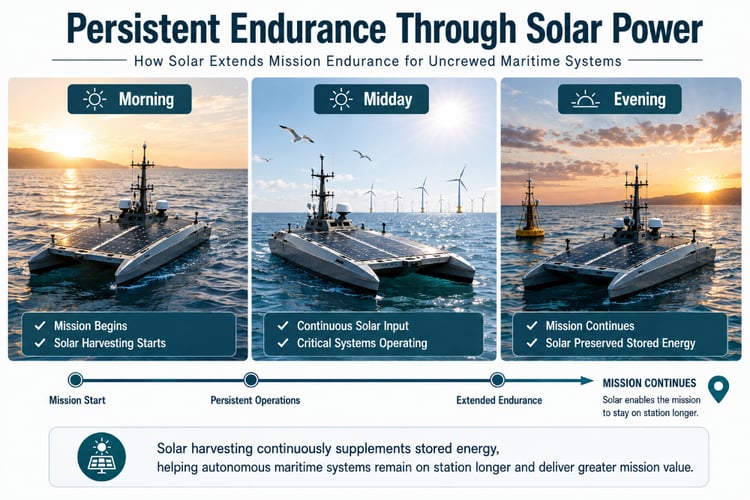
The greatest benefit often comes from preserving battery capacity for nighttime operation, poor weather, or unexpected mission demands.
Solar is only one part of a successful energy architecture. Batteries provide stored energy, solar contributes supplemental power, and power electronics determine how efficiently that energy moves throughout the platform. Our article, Solar Panels vs. Batteries vs. Power Supplies: What You Need to Know, explains how these technologies work together within an integrated power system.
Flexible solar is particularly well suited for uncrewed maritime systems because it can integrate into available deck surfaces while adding minimal weight and maintaining a low profile. This allows engineers to increase available energy without making the tradeoffs that often accompany larger battery packs, such as additional weight, reduced payload capacity, or increased charging time.
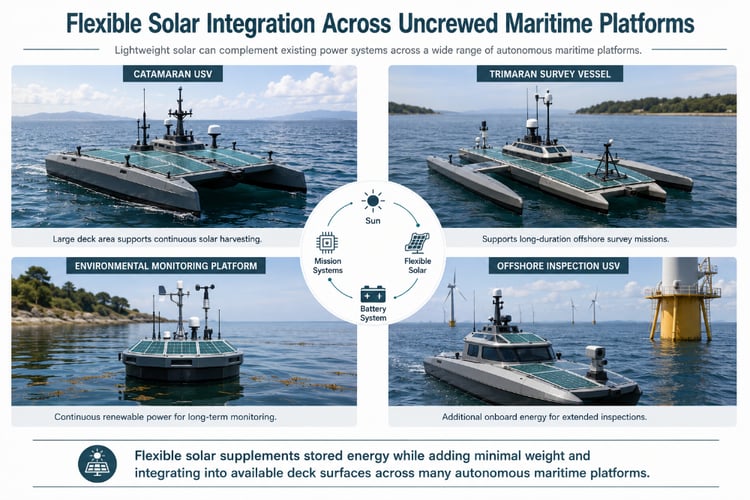
The benefits of solar become even clearer when viewed through real-world mission profiles.
Modern offshore wind farms can span dozens of square miles and include hundreds of turbines.
Autonomous vessels travel between structures, capturing imagery, inspecting equipment, and collecting operational data. Every additional hour on station allows more assets to be inspected before returning to shore, reducing support vessel requirements while improving inspection efficiency.
Researchers increasingly deploy autonomous platforms to monitor water quality, ocean temperatures, currents, weather, and marine ecosystems.
These missions often continue for weeks or months. Recovering a vehicle simply to recharge batteries interrupts valuable datasets and increases operating costs. Solar helps support longer deployments while reducing maintenance visits.
Persistent maritime domain awareness depends on autonomous platforms capable of monitoring strategic waterways for extended periods.
Whether supporting intelligence, surveillance, and reconnaissance (ISR) or protecting critical infrastructure, longer endurance allows autonomous systems to provide more continuous coverage while reducing logistical demands.
Survey platforms routinely cover large geographic areas while collecting bathymetric and geospatial data.
Increasing operational endurance allows larger areas to be surveyed during a single deployment, improving efficiency while minimizing downtime between missions.
Successful solar integration begins long before a vessel reaches the water.
It begins with understanding the mission.
Every deployment is different.
Engineers should evaluate:
These factors determine how much supplemental energy solar can realistically contribute.
Solar performance depends on much more than clear skies.
Latitude, season, cloud cover, vessel orientation, sea state, and daily operating conditions all influence available solar energy. Designing around average operating conditions instead of ideal ones leads to more accurate power budgets and more reliable performance.
Our article, Solar Intensity Explained: Why Solar Panel Performance Depends on More Than Sunshine, explores how environmental conditions affect solar production and why understanding the available solar resource is an important part of system design.
The most effective energy systems treat solar as part of the platform architecture from the beginning.
Considering panel placement, battery management, charge controllers, cable routing, and power distribution early in development often produces better results than attempting to integrate solar after a platform has already been designed.
Autonomous maritime technology continues to evolve rapidly.
Artificial intelligence is enabling more sophisticated onboard decision-making. Sensors are becoming more capable. Communications continue to improve, and operators expect platforms to remain deployed longer than ever before.
Meeting those expectations will require more than larger batteries.
The future of maritime autonomy will be shaped by platforms that intelligently generate, store, and manage energy throughout every mission.
Solar is becoming an increasingly important part of that strategy because it allows engineers to make better use of every watt-hour available. Combined with efficient batteries, intelligent power management, and thoughtful system design, solar helps extend operational endurance while reducing maintenance demands and operating costs.
The future belongs to platforms that generate, store, and manage energy as intelligently as they navigate the ocean.
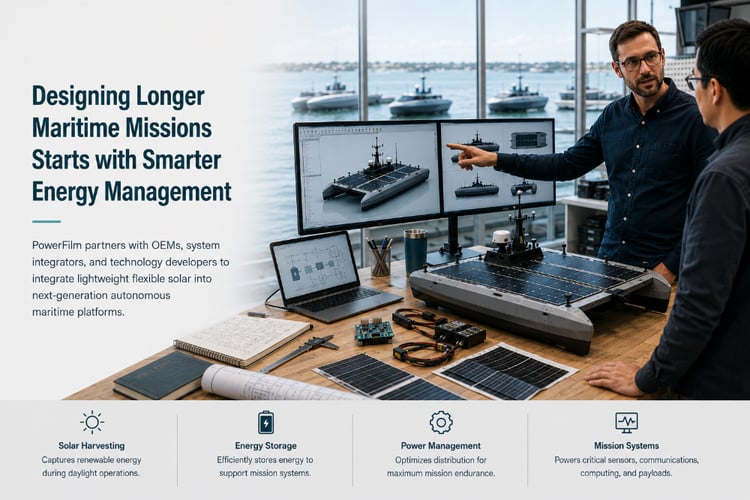
If you're exploring ways to extend the endurance of autonomous maritime platforms, visit our Uncrewed Maritime Systems page or contact us to learn how PowerFilm's lightweight, flexible solar solutions support long-duration deployments in demanding marine environments.
Persistent autonomy is the ability of an autonomous maritime platform to remain operational for extended periods with minimal human intervention. Achieving it requires balancing propulsion, communications, sensing, computing, and energy management to maximize mission endurance.
Modern autonomous platforms carry increasingly sophisticated sensors, processors, and communications equipment. While these technologies expand mission capabilities, they also increase power demand, making efficient energy management essential for long-duration deployments.
In most applications, no. Solar is typically integrated alongside rechargeable batteries to supplement onboard power, reduce battery discharge, and extend operational endurance rather than replace stored energy.
Applications that benefit most include offshore infrastructure inspections, oceanographic research, environmental monitoring, hydrographic surveying, and maritime security missions where platforms remain deployed for extended periods.
Successful integration begins with understanding the mission profile, available installation space, expected environmental conditions, daily sunlight, battery management strategy, and the platform's overall power budget. Considering these factors early helps optimize the complete energy architecture.
By harvesting energy during surface operations, solar helps reduce continuous battery drain, preserve stored energy for critical operations, and extend the amount of time an autonomous platform can remain on station before requiring recovery or maintenance.
Take this blog post with you!

.jpg)