 Seth Hansen
.jpg?width=500&height=300&name=Blog%20post%20%23167%20Indoor%20vs.%20Outdoor%20Solar%20Panels%20Key%20Differences%2c%20Use%20Cases%2c%20and%20Performance%20Considerations%20(Web).jpg)
Originally published: 8-10-18
This blog post was co-created with AI.
Key Takeaways
- Outdoor and indoor solar are designed for different lighting conditions. Outdoor solar is built for sunlight and higher output, while indoor solar is optimized for low-light energy harvesting.
- Power expectations matter as much as placement. Outdoor solar supports battery charging and higher loads, while indoor solar powers ultra-low-power devices.
- The right solution depends on the environment and system goals. Matching the solar technology to where and how it will operate is key to long-term performance.
Solar panels are not one-size-fits-all.
Outdoor and indoor solar panels are designed for fundamentally different lighting environments and power expectations, and understanding that difference is critical when selecting the right solution.
Outdoor solar panels are designed for direct sunlight and significantly higher energy output, supporting battery charging, auxiliary power systems, and higher electrical loads.
Indoor solar panels are optimized for low-light, artificial, or diffuse lighting and generate small amounts of power for energy-harvesting applications.
Choosing between them depends on where the panel will operate, how much power is required, and how reliable that power needs to be over time.
Take this blog post with you!
The Core Difference Between Outdoor and Indoor Solar
.jpg?width=350&height=233&name=Solar%20panel%20in%20the%20sun%20and%20indoor%20solar%20panel%20under%20a%20light%20(Web).jpg)
At a high level, the difference comes down to light intensity and power expectations.
Outdoor solar panels are designed to operate under full sun and convert high-intensity sunlight into usable electrical power. Indoor solar panels are engineered to harvest energy from low-intensity light sources such as LEDs and fluorescents.
While both technologies rely on photovoltaic cells, they are optimized for completely different environments and use cases.
To understand why outdoor and indoor solar behave so differently, it helps to examine the lighting conditions in each environment. Indoor lighting and outdoor sunlight differ by orders of magnitude in intensity, even before accounting for spectrum or duration.
For a deeper look at why brightness can be deceptive, see Solar Intensity: Looks Can Be Deceiving.
For a deeper look at how factors like light intensity, daily exposure, shading, and spectrum influence indoor solar performance, see Characterizing Your Indoor PV Energy Harvesting Environment: 5 Key Factors.
The tables below illustrate how typical outdoor and indoor lighting conditions translate into usable solar power over time.
.jpg?width=400&height=266&name=Common%20Outdoor%20Lighting%20Scenarios%20(Web).jpg)
.jpg?width=400&height=267&name=Common%20indoor%20lighting%20scenarios%20table%20(Web).jpg)
Common outdoor and indoor lighting scenarios. Indoor environments typically provide a fraction of the light intensity available outdoors, which directly impacts solar power generation.
Outdoor vs. Indoor Solar at a Glance
Outdoor Solar Panels
- Designed for direct sunlight exposure.
- Higher power output, from watts to kilowatts.
- Built for energy generation and battery charging.
- Commonly used on vehicles, equipment, and outdoor assets.
Indoor Solar Panels
- Designed for artificial or low-light conditions.
- Lower power output, typically microwatts to milliwatts.
- Optimized for energy harvesting rather than energy generation.
- Commonly used for sensors, IoT devices, and electronics.
How Outdoor Solar Panels Work
.jpg?width=350&height=233&name=Crystalline%20Solar%20panel%20on%20the%20grass%20and%20the%20sun%20is%20shining%20(Web).jpg)
Outdoor solar panels are designed to convert high-intensity sunlight into usable electrical power. Because sunlight is orders of magnitude stronger than indoor lighting, outdoor panels can support battery charging, auxiliary power systems, and higher electrical loads.
Environmental factors play a significant role in outdoor performance. Temperature, panel chemistry, and mounting conditions all affect output.
This post on how temperature impacts solar panel design and performance explains why different solar technologies behave differently in real-world conditions.
Common Use Cases for Outdoor Solar
.jpg?width=350&height=234&name=Solar%20panel%20mounted%20on%20a%20battery%20box%20(Web).jpg)
Outdoor solar is the right choice when higher power output or environmental durability is required.
Common applications include:
- Vehicles, trailers, and mobile assets.
- Remote or unattended equipment.
- Backup and auxiliary power systems.
- Outdoor electronics and infrastructure.
In many of these environments, flexible and lightweight panels offer advantages over rigid alternatives. This overview of flexible solar charging solutions for powering devices anywhere shows how portable solar can deliver reliable power without adding unnecessary weight or complexity.
How Indoor Solar Panels Work
.jpg?width=350&height=234&name=Small%20solar%20panel%20integrated%20into%20a%20black%20box%20charing%20under%20indoor%20light%20(Web).jpg)
Indoor solar panels are designed to operate in environments with light levels far lower than those of direct sunlight. They use photovoltaic materials optimized for low irradiance and the spectral characteristics of common indoor light sources such as LEDs and fluorescents.
Rather than replacing traditional power sources, indoor solar typically provides continuous trickle power, extending battery life and reducing maintenance. This makes indoor solar most effective when paired with ultra-low-power electronics and efficient system design. For a deeper explanation of this behavior, see our post on how indoor solar panels work, which explains what indoor solar can realistically power and why performance expectations matter.
Indoor solar performance is not just about light intensity, but also spectrum. Artificial light sources, such as LEDs, emit light differently from the sun, which directly affects how much usable energy a solar panel harvests.
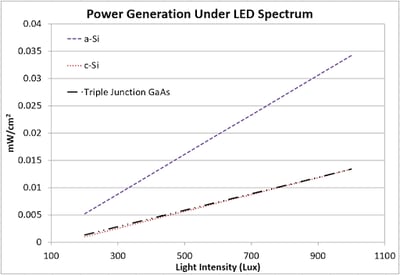
Solar power generation under LED lighting. Panels designed for low-light environments are optimized to harvest energy from the spectral output of common indoor light sources.
Together, light intensity and light spectrum explain why indoor solar panels are purpose-built for specific environments rather than scaled-down versions of outdoor panels.
Because indoor solar is designed for energy harvesting rather than high-output generation, it performs best in applications where reliability and longevity matter more than raw power.
Common Use Cases for Indoor Solar
.png?width=350&height=233&name=Thin-film%20solar%20panle%20integrated%20into%20a%20white%20box%20installed%20on%20the%20wall%20in%20an%20industrial%20setting%20(Web).png)
Indoor solar makes the most sense when power needs are small, but reliability and longevity are critical.
Typical applications include:
- Wireless sensors and monitoring devices.
- IoT systems in warehouses, factories, and offices.
- Smart building controls.
- Low-power consumer and industrial electronics.
Many of these applications rely on energy harvesting rather than energy generation.
If you’re evaluating solar alongside other power options, this comparison of solar panels vs. batteries vs. power supplies provides helpful context for deciding when solar is a good fit.
Placement also matters. Indoor panels may sit behind windows or enclosures, which can impact output. If that’s the case, it’s worth understanding whether a solar panel will work behind glass and how filtered light affects performance.
Performance Expectations: What Solar Can and Cannot Do
.jpg?width=350&height=234&name=outdoor%20and%20indoor%20solar%20panel%20charging%20examples%20(Web).jpg)
Setting realistic expectations is important when choosing between outdoor and indoor solar.
Outdoor solar:
- Can actively charge batteries and support higher loads.
- Depends heavily on sun exposure and placement.
- Requires proper system design for consistent performance.
Indoor solar:
- Does not replace traditional outdoor solar panels.
- Produces small but steady power over time.
- Works best with ultra-low-power electronics.
Efficiency is often misunderstood in these discussions. This explanation of solar cell efficiency and why it matters clarifies why higher efficiency does not always translate to better real-world results, particularly in low-light environments.
Choosing the Right Solar Solution
.jpg?width=350&height=234&name=Man%20deciding%20between%20and%20indoor%20and%20outdoor%20solar%20panel%20(Web).jpg)
When deciding between indoor and outdoor solar, a few questions help guide the process:
- Will the panel receive direct sunlight or artificial light?
- How much power does the device actually require?
- Is the goal battery replacement, battery extension, or active energy generation?
- Will the system be stationary or mobile?
Applications that involve low-light, mobility, or space constraints often benefit from solar technologies designed specifically for those conditions. For a step-by-step guide to evaluating power requirements and sizing a system appropriately, this comprehensive guide to solar power budgeting and system design walks through a practical example.
Aligning panel design to the operating environment is the foundation of long-term, reliable performance. Answering these questions early helps avoid underperforming systems and unnecessary redesigns.
At PowerFilm Solar, solar solutions are designed specifically for environments where traditional rigid panels are impractical, including low-light, mobile, and space-constrained applications. Aligning the technology to the environment is the foundation of successful solar integration.
Have questions about your specific environment or power needs? Contact our team to help you evaluate the right solar approach.
Frequently Asked Questions About Outdoor vs. Indoor Solar
Can indoor solar panels replace batteries entirely?
In some ultra-low-power applications, indoor solar panels can eliminate the need for batteries altogether. More commonly, indoor solar is used to significantly extend battery life and reduce maintenance by providing continuous trickle power rather than serving as a full replacement for batteries.
Do indoor solar panels work under LED lighting?
Yes. Indoor solar panels can work under LED lighting, but performance depends on light intensity and spectrum. Panels designed specifically for low-light environments perform far better under modern LED fixtures than traditional outdoor solar panels, which are typically inefficient indoors.
Can outdoor solar panels be used indoors?
In most cases, no. Outdoor solar panels are optimized for direct sunlight and generally produce negligible power under artificial or low-light conditions. Using an outdoor panel indoors usually results in unreliable and insufficient performance.
How much power can indoor solar realistically produce?
Indoor solar typically produces power in the microwatt to milliwatt range. That output is well-suited for sensors, IoT devices, and other low-power electronics, but not for energy-intensive systems. Indoor solar is best used as an energy-harvesting solution rather than as a primary power source.
Outdoor vs. Indoor Solar: Final Takeaway
Outdoor and indoor solar panels are built for different jobs.
Outdoor solar delivers higher output where sunlight is available and larger energy generation is required.
Indoor solar excels at low-power energy harvesting in controlled lighting environments, where reducing maintenance and extending battery life matter most.
The best results come from matching solar technology to the environment in which it operates, not from pushing a panel beyond its design limits.
Still have questions?
Every application is different. Contact us if you’d like to talk through your requirements or explore whether outdoor or indoor solar makes sense for you.
Take this blog post with you!